

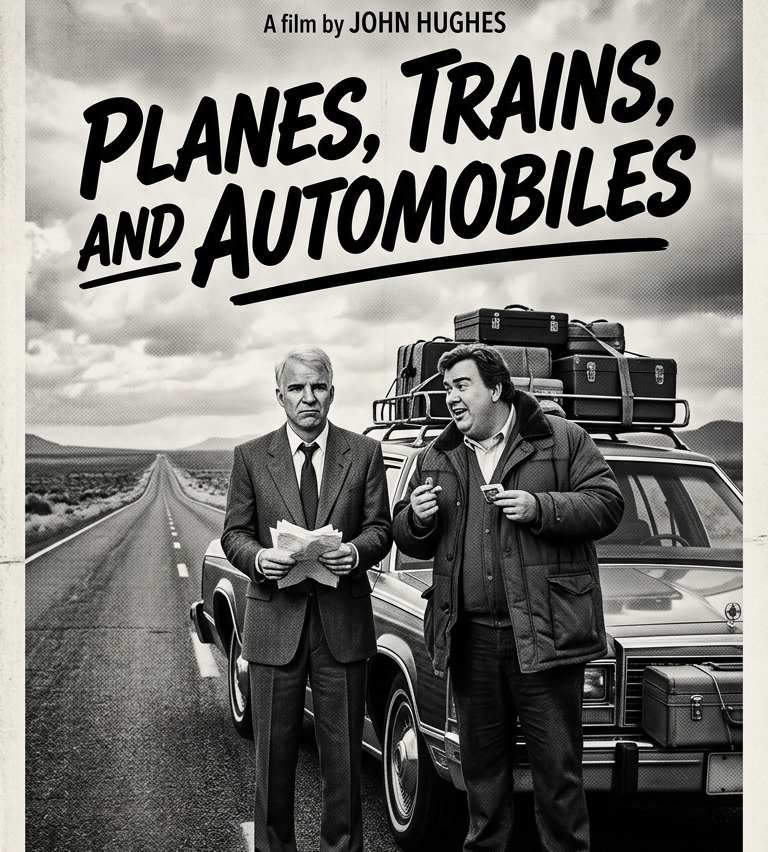
Planes, Trains, and Automobiles look like a loud, slapstick road movie farce: a clean‑cut executive, a gabby sales associate, and a series of travel disasters that keep escalating from one airport to the next. But what makes the film endure is the way it quietly peels back its own jokes to reveal two very ordinary men whose personalities are less opposites than complementary reflections of the same need: for someone to acknowledge they exist. [1][2] Steve Martin’s Neil Page and John Candy’s Del Griffith does not just share a journey; they share a kind of emotional circuitry, and the film’s real engine is the slow, awkward wiring of that connection. [1][3]
Neil, an advertising executive racing home to Chicago for Thanksgiving, is all repressed about urgency and micro controlled frustration. His suit is ironed, his schedule is tight, and his entire identity is built on the fantasy that he can outmaneuver chaos. [1][2] Martin, already a master of comic rage, plays Neil with a tighter, more specific kind of exasperation than in his earlier broad farces. [3][4] Here, the anger feels like a reflex conditioned by corporate life and commuter anxiety; when planes get canceled, rental cars catch fire, or hotel rooms are double-booked, his explosions are less cartoonish than humanly proportional to the absurdity he is facing. [1][2] The famous “Are you finished?” The scene is not just a punch line; it is the release valve on a day that has become a continuous allergic reaction to incompetence and bad luck. [3][5]
Del Griffith, by contrast, is a human pressure valve. A shower‑curtain‑ring sales associate whose personality is a blend of relentless optimism and boundary free social navigation, Del is the kind of person who talks so much that he never has to sit with his own silence. [1][3] Played by John Candy with a generosity that feels almost instinctive, Del is never just “the annoying sidekick.” [4][6] His jokes, his life‑advice monologues, his invasions of personal space—all are layers on top of a character who is, in truth, profoundly alone. [3][7] The film hedges this early with a couple of throwaway lines and a hotel‑room gag, but it does not fully commit to the revelation until the now‑legendary bedroom confession, where Del’s carefully constructed persona briefly collapses. [1][3] In that moment, Candy peels back to the surface and shows that Del’s exuberance is partly performing, a way of faking the kind of belonging he never actually had. [4][8]
Around them, a small but precise ensemble grounds the film in a recognizably real world. Laila Robins as Neil’s wife, Susan, Michael McKean as the unnervingly polite state trooper, Dylan Baker as the redneck truck driver, and a handful of Hughes era staples like Edie McClurg and Ben Stein all pop up at just the right moments to remind the viewer that travel is a social relay race of strangers, each passing the baton of awkwardness, politeness, and impatience. [1][9] None of these supporting turns overplaying their material; they feel like the people you meet in airport terminals and highway motels—over‑loud, under‑rested, and just trying to get where they are going. [9][3]
What is striking in retrospect is how little the film relies on punch‑line‑driven plotting. Instead, it leans on the rhythm of mutual irritation, hardening into something closer to care. [2][4] By the time Neil flips the “Thank You” display in his office window, the film has quietly transformed from a travel comedy into a minor domestic fable about the unexpected forms that friendship can take. [1][3] For a critic steeped in classic cinema and careful character work, this is the most satisfying kind of mainstream comedy: one whose laughs are built into recognizable human behavior, not into comic set pieces for their own sake. [6][10]
Cinematography, Sets, and the Time Machine Quality of 1987
If the film’s first act is defined by the collision of personalities, its visual language is equally defined by the collision of spaces. Planes, Trains, and Automobiles do not just move its characters from one mode of transport to the next; it moves them through a series of environments that feel increasingly stripped of comfort and control. [1][9] The film’s cinematography, handled by Donald Peterman, is deliberately unshowy, favoring clean, slightly flat compositions that keep the focus on faces, dialogue, and the cramped quarters in which Neil and Del are forced to share air. [11][4] This restraint is crucial: the comedy lives in the actors’ timing and the way their bodies fill—or overflow—the frames, not in flashy camera moves or elaborate setups. [1][3]
The palette is dominated by the muted tones of late fall travel: the cool greys of airport terminals, the washed-out blues of rental‑car lots, the dull browns of highway motels and train car interiors. [9][4] These colors are not just atmospheric; they mirror the emotional state of the film’s protagonists. [3][10] As the journey stretches on, the world feels less like a series of destinations and more like a looping purgatory of delays, cancellations, and unsatisfactory accommodations. [1][5] Only when the film finally lands in Neil’s suburban home does the color temperature shift, the warmer interiors and softer lighting suggesting that the real climax of the trip isn’t the arrival at a place, but the restoration of a self within a familiar context. [9][10]
Production design and location choices also give the film a quiet time machine quality. Shot in New York and Illinois, with exteriors in places like Batavia, South Dayton, Braidwood, and Woodstock, the movie recreates a mid‑level, pre-Internet version of American travel. [1][9] The Sun Motel, where Neil and Del are first double‑booked into the same room, feels like a real chain establishment, its cinder‑block walls, generic linoleum, and impersonal signage radiating the kind of unpretentious anonymity that defined roadside lodging in the 1980s. [9][12] Airports, train stations, and rental‑car counters are all rendered with a matter‑of‑fact realism: the ticket counters, the waiting areas, the rows of rental‑car desks, the luggage‑claim chaos. [1][9] There is no stylized “movie travel” aesthetic; instead, the film feels constructed from the actual materials of everyday movement. [9][3]
John Hughes, directing his own script, uses these spaces to stage a kind of accidental intimacy. [1][4] The forced proximity of the rental car seats, the same motel bed, the rear of a pickup truck—each confinement becomes a small chamber of enforced closeness, where every awkward shift, muffled insult, and reluctant compromise nudges the two leads toward a fragile understanding. [3][10] The film’s editing, handled by Paul Hirsch, keeps the rhythm brisk but never frenetic, allowing the comedy to breathe while still preserving the sense that time is slipping away from Neil. [13][4] There are no overly obvious montages or hyperkinetic transitions; instead, the film’s structure feels like a series of escalating inconveniences that gradually chip away at Neil’s defenses, until the only thing left standing is a grudging recognition that Del is not just an obstacle, but a mirror. [3][5]
From a cinematic historical standpoint, this is one of Hughes’ most formally disciplined films. [1][6] It does not lean on the heightened symbolism of Ferris Bueller’s Day Off or the emotional focus of The Breakfast Club; instead, it leans on the observational strength of a filmmaker who can see the theatricality in mundane situations. [4][10] The camera doesn’t “comment” on the action so much as document it, and in doing so, the film inherits a quality often associated with classic studio comedies: the sense that the world around these characters is real enough to bump into, and funny enough to laugh at when it does. [3][6]
Reception, Legacy, and the Thanksgiving Afterglow
When Planes, Trains, and Automobiles arrived in 1987, it was something of an anomaly in John Hughes’ filmography. [1][4] He was already known as the architect of teen centric coming‑of‑age films, but this was an adult skewing comedy built on the chemistry of two performers who had never shared the screen in such a concentrated way. [1][6] Critics responded with a mixture of surprise and admiration, noting how Hughes had managed to blend outrageous physical comedy with an undercurrent of emotional seriousness that never slipped into sentimentality. [4][5] The film’s script earned a Writers Guild of America nomination, and reviewers praised its ability to escalate set pieces—one after another—while never losing sight of the relationship at its center. [1][4]
Audience response was similarly warm, though the film’s stature grew more slowly than some of Hughes’ earlier hits. [2][4] It was not an instant box-office titan, but it found a second life as a Thanksgiving staple, a seasonal companion piece to road movie traditions and holiday travel anxiety. [2][8] Over time, it became enshrined in critical “best of”
Add comment
Comments