

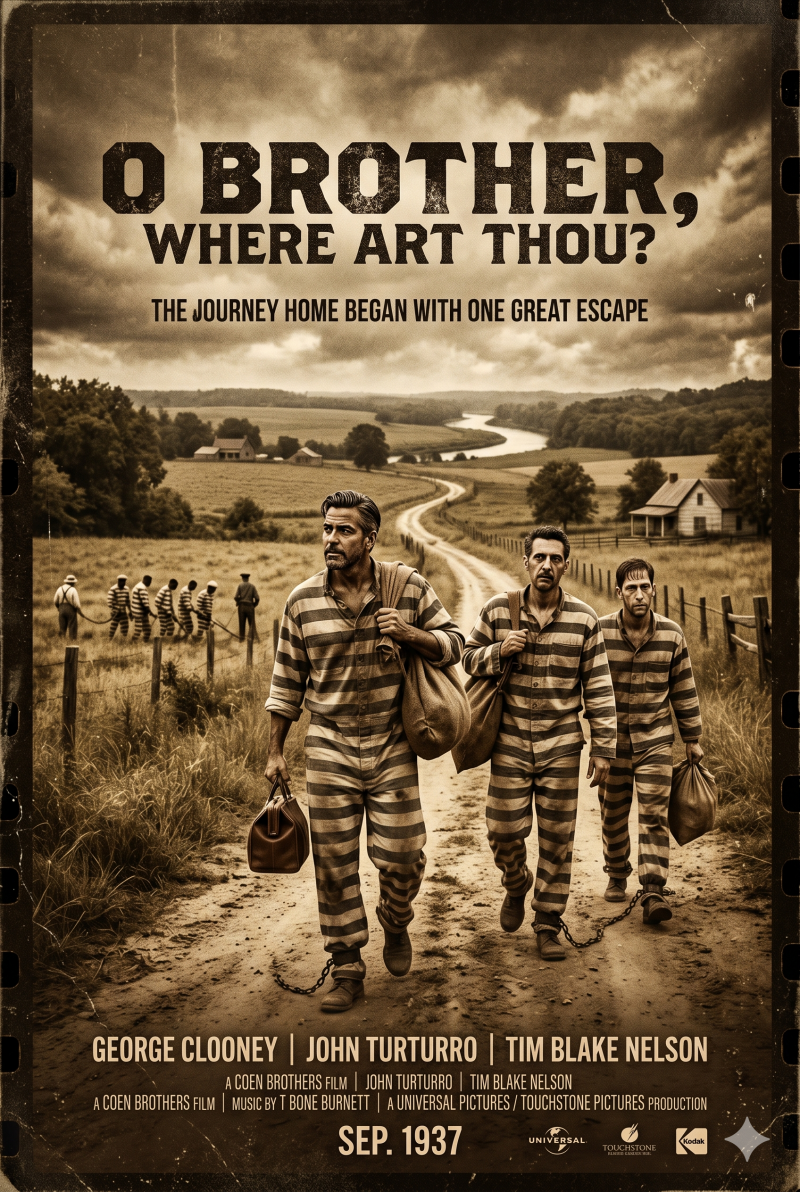
Few films have aged as gracefully—or as strangely—as O Brother, Where Art Thou?. Released in 2000, the Coen Brothers’ dusty Southern epic arrived as a screwball comedy, a folk musical, a prison-break adventure, and a mythological retelling all at once. Twenty-five years later, it still feels impossible to categorize.
Part of the film’s staying power comes from its contradictions. It’s deeply literary but proudly goofy. It satirizes politics while indulging in myth. It mocks nostalgia even as it wraps itself in sepia-toned Americana. And somehow, through all of that, it became one of the most influential music films of the modern era.
What follows is a closer look at why the movie still resonates: from its Homeric roots and groundbreaking soundtrack to its revolutionary cinematography and endlessly quotable dialogue.
Part 1: The Modern Odyssey in Dapper Dan Grease
The Coens famously claimed they had not fully read Homer’s Odyssey before making the film, but the parallels are unmistakable. O Brother, Where Art Thou? openly transforms ancient Greek mythology into Depression-era Mississippi, turning Ulysses Everett McGill into a chain-gang Odysseus armed with pomade instead of a sword.
George Clooney’s Everett is a con man, a fast talker, and a self-mythologizing drifter obsessed with appearances. Like Odysseus, he survives not through strength but through improvisation. His “journey home” becomes less about treasure and more about identity, family, and survival in a rapidly changing America.
The Cyclops in the Bible Belt
John Goodman’s Big Dan Teague is one of the film’s clearest mythological stand-ins. The one-eyed Bible salesman mirrors the Cyclops Polyphemus from Homer’s epic almost beat for beat.
But the Coens make the character distinctly American. Big Dan weaponizes religion, charm, and populist performance, embodying the danger lurking beneath Southern hospitality. Goodman plays him with terrifying unpredictability: one moment jovial, the next brutally violent. The result is one of the film’s funniest and most unsettling sequences.
The Sirens by the River
The famous riverbank laundry scene remains one of the movie’s most hypnotic moments. The women washing clothes and singing “Didn’t Leave Nobody but the Baby” evoke the Sirens from The Odyssey, luring men toward destruction through beauty and music.
The sequence works because the Coens never over-explain it. It exists somewhere between dream, folklore, and hallucination. Like much of the film, it feels inherited rather than written—as if the story had always existed in American oral tradition.
Prophets on the Railroad Tracks
The blind railroad prophet who opens the film functions as the story’s Tiresias figure, warning Everett and his companions about the trials ahead. Throughout the movie, seers and symbolic guides repeatedly appear, steering the “Soggy Bottom Boys” toward fate.
Even the radio station becomes prophetic. The trio unknowingly records a hit song that spreads across Mississippi before they understand its significance. Fame travels faster than the men themselves, turning them into myths in real time.
Part 2: The High Lonesome Sound — How Bluegrass Saved Cinema
You cannot discuss O Brother, Where Art Thou? without discussing the soundtrack. Curated and produced by T Bone Burnett, the music was not treated as background decoration—it was foundational to the film itself. In fact, much of the soundtrack was recorded before filming even began.
The gamble paid off spectacularly.
The soundtrack became a commercial phenomenon, won the Grammy for Album of the Year, and helped ignite a mainstream revival of bluegrass, folk, gospel, and old-time American roots music.
The Soggy Bottom Boys and “Constant Sorrow”
“I Am a Man of Constant Sorrow” became the film’s defining anthem. Although George Clooney performed the role onscreen, the vocals were dubbed by bluegrass musician Dan Tyminski.
That separation between image and voice is central to the movie’s themes. Everett and his companions accidentally become celebrities through performance. Their authenticity is questionable, but their emotional resonance is real.
The song itself feels timeless because it practically is. The film revived traditional American music not by modernizing it, but by presenting it sincerely.
Music as Survival
Unlike many musicals, the songs in O Brother are not interruptions from reality—they are reality. Music becomes currency, disguise, emotional release, and social connection.
The trio escapes prison labor, navigates political rallies, and survives public humiliation largely through performance. In the Coens’ Mississippi, music is one of the few democratic forces left. Anybody with a guitar and a voice can reshape their destiny.
The “O Brother Effect”
The soundtrack’s cultural impact is difficult to overstate. It topped charts, sold millions of copies, and exposed a new generation to artists and traditions that mainstream radio had largely ignored.
Its influence still echoes today in the rise of Americana and roots revival artists. Even recent anniversary celebrations at the Grand Ole Opry frame the soundtrack as a landmark moment in modern folk music history.
Part 3: A Vision in Sepia — The Color of the Depression
Visually, the film changed Hollywood.
O Brother, Where Art Thou? became one of the first major feature films to rely heavily on digital color grading. Cinematographer Roger Deakins and the Coens digitally transformed lush Mississippi greens into dusty browns and faded golds, creating the movie’s instantly recognizable Depression-era palette.
Digital Alchemy
The filmmakers reportedly struggled with the naturally vibrant Southern landscape because it looked “too healthy” for the mythic poverty they envisioned. The digital grading stripped the world of vitality, creating a dreamlike visual texture that resembled faded postcards and old photographs.
At the time, this approach was groundbreaking. Today, digital color correction is standard filmmaking practice, but O Brother helped prove the artistic possibilities of the technology.
Nostalgia and Myth-Making
The sepia tones do more than establish historical setting. They create emotional distance.
The movie does not depict the Depression realistically so much as remember it collectively. Every frame feels filtered through folklore and exaggeration. The South becomes a land of wandering prophets, corrupt politicians, flood myths, and radio celebrities—a place halfway between history and legend.
That mythic quality explains why the film still feels timeless. It was never trying to be literal.
Part 4: The Politics of the Pappy O’Daniel Era
Beneath the slapstick comedy lies a sharp satire of American politics.
Governor Pappy O’Daniel and Homer Stokes represent competing visions of Southern identity: one rooted in old-school populism and spectacle, the other openly fueled by extremism and fear.
The Reform Candidate and the Fraud
Homer Stokes presents himself as a moral reformer while secretly leading the Ku Klux Klan. The joke is obvious, but the critique remains relevant. The Coens portray politics as performance long before social media transformed every politician into a brand.
Pappy, meanwhile, survives largely because he understands entertainment. He senses the crowd turning toward the Soggy Bottom Boys and immediately adapts. Ideology matters less than controlling the show.
The KKK Sequence
The Klan rally sequence is one of the movie’s boldest creative decisions. Rather than depict the KKK with solemn realism, the Coens frame the rally as grotesque choreography—part Busby Berkeley musical, part nightmare pageant.
By turning hate into absurd spectacle, the film strips the organization of mystique and exposes its theatricality. The scene remains uncomfortable, but intentionally so.
The Flood and the End of an Era
The film’s climactic flood symbolizes modernization swallowing the old South whole. The Tennessee Valley Authority looms over the story as both progress and destruction.
Communities vanish beneath reservoirs. Traditions disappear. Myth gives way to infrastructure.
Yet the film never fully condemns or celebrates this transition. Like Everett himself, America is caught between reinvention and nostalgia.
Part 5: “We’re in a Tight Spot!” — Why the Dialogue Still Lives Forever
The Coens write dialogue unlike anyone else in American cinema. Their characters speak in heightened rhythms that sound literary, musical, and absurd all at once.
In O Brother, Where Art Thou?, every line feels simultaneously over-written and perfectly natural.
Everett’s Eloquence
George Clooney gives perhaps the funniest performance of his career as Everett McGill, a man whose vocabulary exceeds both his intelligence and his circumstances.
His obsession with diction becomes character comedy:
“I’m bona fide!”“We’re in a tight spot!”“I’m a Dapper Dan man!”
Everett believes language itself can elevate him above poverty and chaos. Clooney plays this desperation beautifully, turning every sentence into a miniature performance.
The Rule of Three
The chemistry between Everett, Pete, and Delmar forms the emotional center of the movie.
Pete is cynical frustration. Delmar is innocent optimism. Everett exists somewhere between manipulator and reluctant leader. Their rhythm feels ancient, echoing vaudeville routines, folk storytelling, and classic comedy trios.
Without that dynamic, the movie’s stranger elements would collapse.
Why the Quotes Endure
Few movies from the early 2000s remain as endlessly quotable. The dialogue survives because it sounds handcrafted. The Coens treat speech like music: repetitive, rhythmic, exaggerated, and memorable.
The lines persist in popular culture because they are fun to say aloud. They carry texture.
And perhaps that is the secret of the entire film.
Like the folk songs woven through its soundtrack, O Brother, Where Art Thou? survives because it feels passed down rather than manufactured—an American tall tale disguised as a comedy about escaped convicts searching for treasure, hair pomade, and home.
Add comment
Comments